
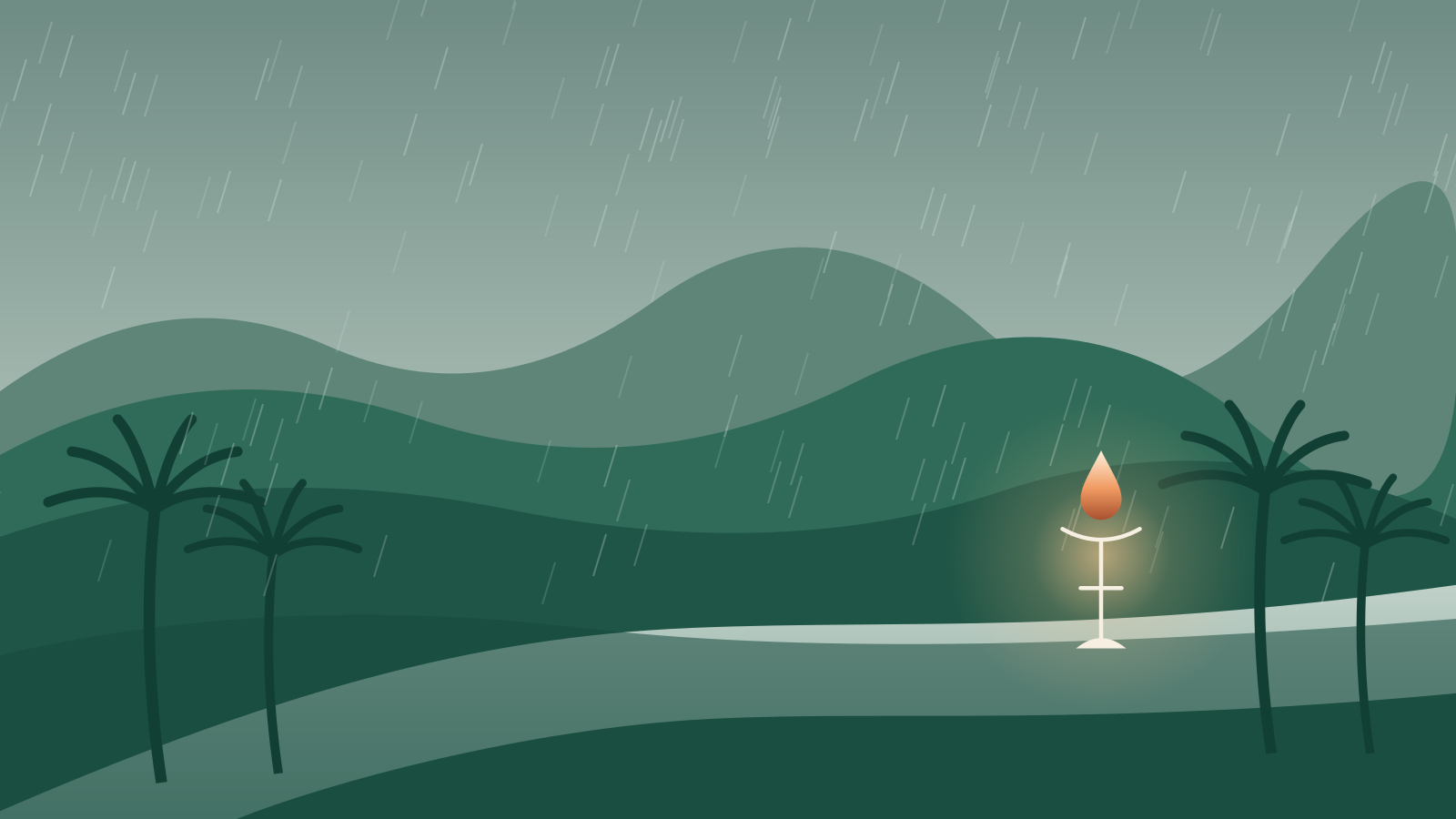
Stand anywhere in Kerala in early June and you hear it before you see it.
A low roar moves in from the Arabian Sea. The sky turns the colour of slate. Then the rain arrives, not as a shower but as a wall, and for the next few months it barely stops. The rivers swell. The hills turn a green so deep it looks painted. Everything grows.
The monsoon is not just weather in Kerala. It is the reason so much of what follows in this story was possible.
In the last post, we traced Ayurveda back more than two thousand years, to the classical texts of the north, and followed it south. We ended with a question. Ayurveda was practised all over India, so why is it Kerala, more than almost anywhere else, that the world now links with authentic Ayurveda?
The first part of the answer is the land itself.
A land made for medicine
Kerala is a narrow strip of land between the Arabian Sea and the Western Ghats, the long mountain range that runs down India's west coast. It receives not one monsoon but two: the southwest monsoon from June to September, and the northeast monsoon in October and November. Forty-four rivers run through it.
The Western Ghats are one of the world's great biodiversity hotspots, recognised as a UNESCO World Heritage Site. Their forests hold an extraordinary range of plants, many of them used in medicine for centuries.
For a physician, this changed everything. In much of the world, healers depended on dried herbs carried over long distances. In Kerala, many medicinal plants grew within walking distance, all year round. Physicians could work with fresh leaves, roots and bark, and that freshness shaped how Kerala's medicines were made.
The forest in the backyard
The forest did not stay in the hills. It came home.
Across Kerala, small patches of forest called kavu, sacred groves, were protected around shrines for generations. No one cut them. Over time they became living libraries of plants, some of which are now rare elsewhere.
Home gardens did the same work on a smaller scale. Tulsi by the doorstep. Curry leaves, turmeric, ginger and pepper growing between the coconut palms. Knowing plants was not specialist knowledge. It was part of growing up.
The book that showed the world
In the late 1600s, the rest of the world noticed.
Hendrik van Rheede, the Dutch governor of Malabar, set out to document the region's plants. The work he oversaw, the Hortus Malabaricus, was published in Amsterdam between 1678 and 1693, in twelve volumes describing around 740 plants and their uses.
What makes it remarkable is where the knowledge came from. Much of it was supplied by local physicians, among them Itty Achuden, a celebrated healer from a family of physicians, working alongside Konkani Brahmin scholars. Plant names appeared in Malayalam alongside other scripts. It became one of the earliest major works on the plants of tropical Asia, and it rested on the knowledge of Kerala's own healers.
Climate shaped the treatments
Kerala's weather did not only supply the herbs. It shaped the medicine.
The heaviest rains fall in Karkidakam, the monsoon month of July and August. Traditionally, it was a time to slow down, eat lighter food like Karkidaka kanji, a medicinal rice gruel, and take Ayurvedic care. Many families still follow it.
Kerala also became known for therapies that are now recognised as its own: dhara, where a steady stream of warm medicated liquid is poured over the body or forehead; pizhichil, a treatment with warm medicated oil; and njavarakizhi, where bundles of rice cooked in milk and herbs are applied to the body. These grew out of a place with abundant oils, rice, milk and fresh herbs, and physicians who refined them over generations.
Knowledge that never left home
There is one more reason, and it may be the most important.
In many parts of India, Ayurveda lost ground over the colonial centuries. In Kerala, it never left daily life. It stayed in kitchens and gardens, in the rhythms of the monsoon, and above all in the families of physicians who kept practising, teaching and passing it on.
The land made Kerala's Ayurveda possible. Its people kept it alive.
Coming next
The land gave the herbs. But who held the knowledge? Who decided which leaf, which oil, which treatment, for which person?
For centuries in Kerala, the answer was a small group of remarkable families.
Next in The Ekashastra Journal: The Ashtavaidyas: Kerala's Families of Physicians.
Read the series: The Lamp Lit Every Evening (Post 1) · Ayurveda Before Kerala (Post 2).
This post is shared for cultural and educational interest. It is not medical advice. For any health concern, please consult a qualified Vaidya or doctor.